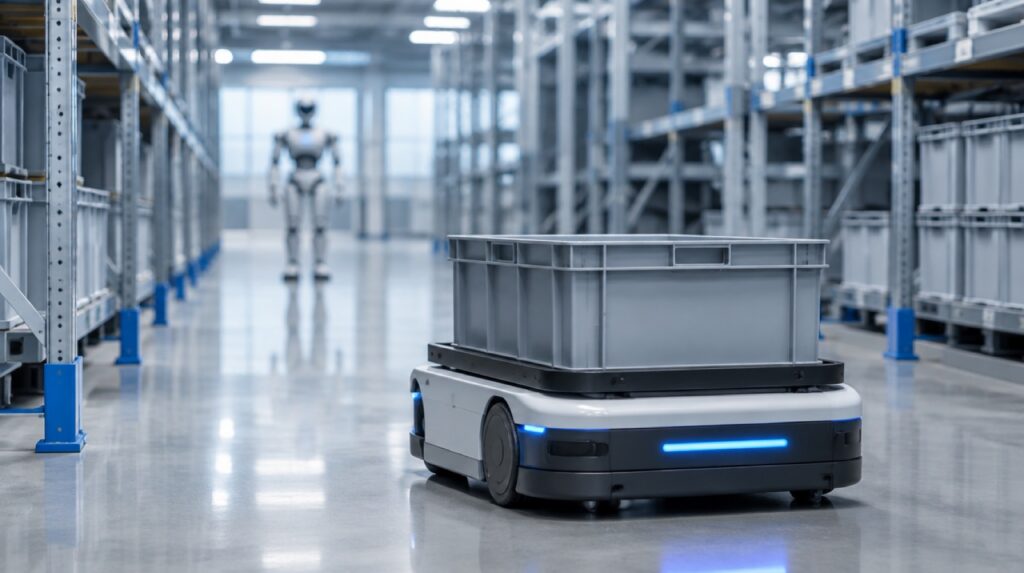
Robots are real in factories and warehouses, early in pilots for humanoids, and mostly still promises in the home. The International Federation of Robotics counts a record five million industrial robots at work, but only about 7,000 full-size humanoids were sold in 2025, and most current uses are specialised.
Key takeaways
- Factories are where robots are real: the International Federation of Robotics (IFR) counts a record five million industrial robots in operation, with more than 600,000 installed in 2025.
- Humanoids are early: the IFR says about 7,000 full-size units were sold in 2025, with most current uses specialised and often needing human teleoperation.
- Tesla’s Elon Musk said on 21 October that deliveries of Optimus to outside customers would likely come toward the end of 2027, according to Humanoids Daily. That is his expectation, not a delivered product.
- Home humanoids such as 1X’s NEO have announced 2026 deliveries, but we could not confirm from a reliable source that customer deliveries have begun.
- A useful test for any robot announcement: who is using it today, doing what, and with how much human help?
What does “physical AI” mean?
“Physical AI” is a label for AI that controls something in the real world, such as a robot arm, a warehouse vehicle or a humanoid, rather than producing text or images. The idea is that the kind of AI model that now drafts emails could help a machine understand a scene and decide what to do. That idea is plausible and under active development. Whether it works reliably enough to leave unsupervised in a kitchen or a care home is a question 2026 has not yet answered. If you are more interested in the software side of AI at work, our overview of where AI stands in late 2026 covers the assistants.
How many robots are really at work?
The IFR published its World Robotics 2026 figures in September. These are statistics rather than forecasts by a robot maker, so they are the firmest ground in this article.
| Measure (2025 unless stated) | IFR figure |
|---|---|
| Industrial robots in operation | Record 5 million, up 9% |
| New industrial robots installed | More than 600,000, up 11% |
| Installed in China | 354,000, about 59% of the global total |
| Professional service robots shipped | Almost 250,000, up 24% |
| Transport and logistics service robots | 117,500, up 21% |
| Consumer service robots (mostly domestic) | Almost 34.2 million, up 37% |
| Surgical robots sold | 8,400, up 57% |
| Full-size humanoids sold | About 7,000 |
The IFR also projects 655,000 industrial installations in 2026 and 806,000 by 2029. Those are projections. For service robots, the IFR cautions that the data come from a sample of 238 suppliers and discourages comparing figures across different World Robotics reports. We read the service robot release as reproduced by the Zawya news service.
In plain terms, the robots that are real are specialised machines that repeat well-defined jobs in controlled spaces.
Where do humanoids stand?
The IFR says about 7,000 full-size humanoids (taller than 140 cm) were sold in 2025, with most current uses specialised and often relying on human teleoperation. Seven thousand is a start, but beside more than 600,000 industrial installations in a single year it shows how young the market is.
What the companies say about the next stage
- Tesla. TechCrunch reported on 21 October that Tesla had started Optimus production at its Fremont factory, quoting the company’s description of the first production-quality robots, and that Musk called it “early production” with a slow and “somewhat bumpy” ramp. Humanoids Daily adds that Musk said on the earnings call that outside customer deliveries are likely toward the end of 2027, and notes that Tesla missed its own first-quarter 2026 target for revealing the next version.
- Figure. According to Humanoids Daily, Figure declared a “full design lock” for its next robot in May and said at an all-hands on 22 October that actuators were running in its test lab. The outlet’s own estimate for a reveal is late 2026 or early 2027. That is the outlet’s estimate, not Figure’s commitment.
- Apptronik. The same article says Apptronik quietly added Apollo 2 to its website in June and estimates, with low confidence, that its next robot will come in 2027.
Are home robots real yet?
Mostly promises, with some exceptions. The best-known home humanoid is 1X’s NEO. The Next Web reports that 1X has a 58,000 sq ft factory in Hayward, California with year-one capacity of 10,000 units and a target of more than 100,000 a year by the end of 2027. It also reports that robots from the factory go through internal testing before customer deliveries begin. Humanoids Daily lists NEO deliveries as promised by the end of 2026.
Is NEO in customers’ homes yet? We could not establish that from a reliable, dated source, so we treat it as unconfirmed. Earlier coverage also raised the question of remote operation, where a human can control the robot to help it, so ask any vendor how much help is involved.
By contrast, robot vacuum cleaners and lawn mowers are real, widely sold and, as the IFR consumer figure shows, selling in the tens of millions.
How can you judge a robot announcement?
- Who is using it, today, doing what? A named factory doing a named task beats a demo video.
- How much human help? Remote operators, scripted routines and a clean test area all change what a demo means.
- Is there an order page and a delivery date? If not, it is a prototype.
- Is the date a target or a delivery? “Expected by” is an intention. Tesla’s missed first-quarter 2026 target is a reminder.
- Who is giving the number? An industry body such as the IFR counts shipments; a company giving a forecast is making a prediction.
What does this mean for office and home users?
For most readers the practical effect of robotics in 2026 is indirect: faster warehouse logistics, more automated factories and better robot vacuums. A household humanoid doing your washing-up is, on current evidence, a matter of years rather than months, and anyone who says exactly when is making a forecast.
The AI progress that helps your computer is more immediate. It already assists with documents and spreadsheets, as we explain in AI in Windows and Office. Browse more explainers on the TheUnitySoft blog, and for the software your own PC runs on, see our Windows licences.
Frequently asked questions
Can I buy a humanoid robot for my home in the UK?
Not as a finished, autonomous household appliance, as far as we could confirm. 1X’s NEO has announced 2026 deliveries, but we have not found a confirmed UK availability date.
Are robots taking jobs?
The evidence is mixed and mostly concerns factories and warehouses. The IFR’s figures show strong growth in installations, but they do not measure effects on employment.
What is the difference between a service robot and a humanoid?
A service robot is any robot doing a job for people outside factory production, such as cleaning or delivery. A humanoid is designed to resemble a human body; most service robots are not humanoid.
Why do robot timelines slip so often?
Building a machine that works reliably around people is hard, and companies announce targets before the hard problems are solved. Treat any date as a target until a product is shipping.
Sources
- Five Million Robots now Operate in Factories Globally (IFR, 24 September 2026). Accessed 26 October 2026.
- Global Sales of Professional Service Robots Surge 24% (IFR press release as reproduced by Zawya, 30 September 2026). Accessed 26 October 2026.
- Tesla’s Optimus Gen 3, Figure 04 and the next Apollo (Humanoids Daily, 26 October 2026). Accessed 26 October 2026.
- Tesla starts Optimus robot production in California as profit falls 43% (TechCrunch, 21 October 2026). Accessed 26 October 2026.
- OpenAI-backed 1X opens California factory targeting 10,000 home humanoid robots in year one (The Next Web). Accessed 26 October 2026.